 English
 Latviešu
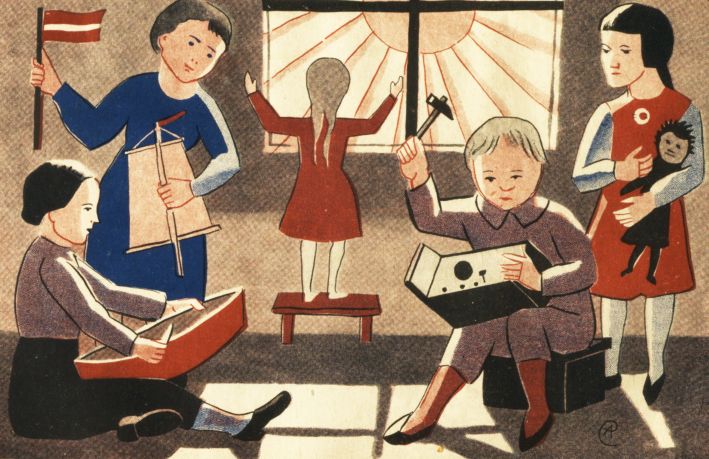
11.08.–10.10.2015. The Museum of Romans Suta and Aleksandra Beļcova, Riga, 57a Elizabetes Street, Apt. 26 (entrance from the courtyard, 5th floor). Corator of the exhibition – Irēna Bužinska.
Latvian press publications ensure lots of surprises, offering a richer idea not just about Latvian cultural history as such, but also about individual and previously unknown episodes in the creative lives of outstanding writers and artists. Among them was the distinguished poet and playwright Jānis Pliekšāns (Rainis, 1965–1929), who took part in producing the children’s magazine “Jaunais Cīrulītis” (Young Lark).
The Latvian Association of Friends of Children offered the job to Rainis, and when he became its publisher in mid-1926, he wanted to improve the literary content and artistic quality of the magazine. Rainis was concerned about “raising children” and offering new proposals as to their own creativity. Rainis became the senior editor of the magazine with the 6th issue of 1926 and continued at the job until the 10th issue of 1927. Colleagues included the writer Kārlis Dziļleja, the artist Sigismunds Vidbergs, the teacher Marta Bīlmane, the journalist and actor Hermanis Kaupiņš, and others.
Although Rainis worked for “Jaunais Cīrulītis”, only for a short period of time, he had a positive effect on the magazine’s image and content. The poetry section of the magazine included poems by Jānis Rainis, drawings by Sigismunds Vidbergs, and work by Kārlis Dziļleja, Herberts Dorbe, Kārlis Skalbe, and others. “Jaunais Cīrulītis”, also published works by some of the world’s greatest authors – stories from Lev Tolstoy as well as poems by Shakespeare and La Fontaine.
Artists who provided cover illustrations and other images included well-known artists such as Aleksandra Beļcova, Uga Skulme, Oto Skulme, Ansis Cīrulis, Indriķis Zeberiņš and Niklāvs Strunke. The latter artist in particular had a long and fruitful relationship with the magazine.
Children and teenagers were asked to send in their own stories and drawings. Teacher and poet Antonija Āre offered practical advice on making toys for children. Her texts were supplemented with drawings by her daughter, Zina, who was a student of Romans Suta. Rainis also entrusted Zina Āre with the artistic design of his compendium of poetry, “Twelve Months”. Another Suta student, Aleksandrs Šutka, also worked successfully for the magazine as a writer and artist.
The title of this exhibition is based on the Rainis poem “What Did the Little Lark Say?” The poem was published in the 6th issue of the magazine in 1926, when the poet began his work as its editor. The exhibition includes only a small selection of illustrations that helped to improve the visual language of the children’s magazine.
Many thanks for the collaboration to the National Library of Latvia!

Leave a Reply
You must be logged in to post a comment.